
Six Trigonometric Ratios – Complete Guide for Beginners and Students
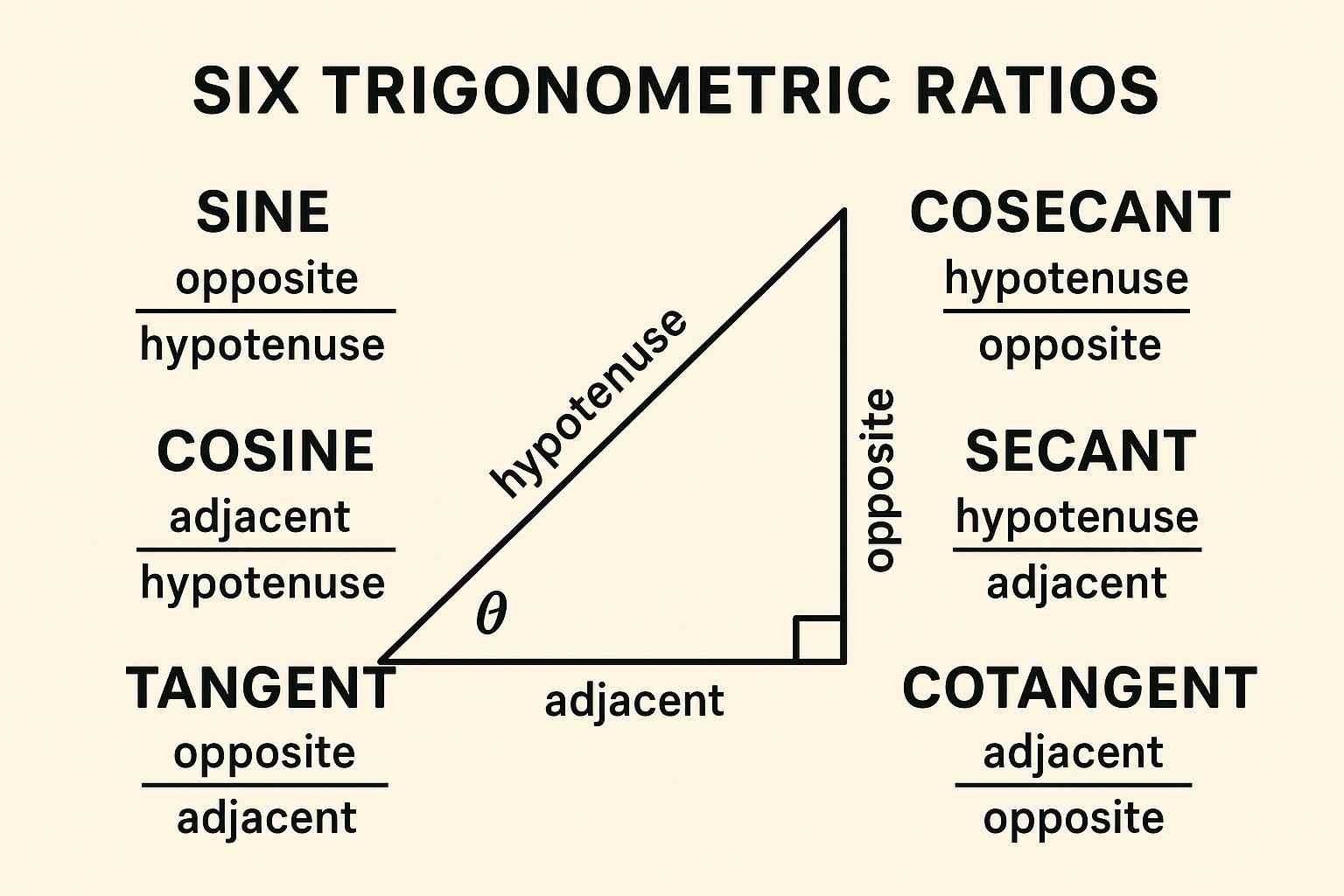
Hello and welcome! Trigonometry might sound intimidating at first, but it’s one of the most useful areas of mathematics. At its core, trigonometry is all about understanding the relationships between angles and sides of triangles. Once you understand the six fundamental trigonometric ratios, you can solve real-world problems, explore advanced math topics, and even appreciate how math connects to daily life. This guide will walk you through each ratio, step by step, with examples, diagrams, and practical tips.
1. Introduction to Trigonometry
Trigonometry is a branch of mathematics that deals with triangles, especially right-angled triangles, and the relationships between their sides and angles. The word “trigonometry” comes from Greek: trigonon (triangle) and metron (measure). In simpler terms, trigonometry is the study of how triangles behave.
It has countless applications: architects use it to design buildings, engineers use it to calculate forces, pilots use it for navigation, and even game developers use trigonometric functions to create realistic movements in 3D worlds. By learning the six basic trigonometric ratios, you gain the key to solving many practical problems with ease.
2. Right-Angle Triangle Basics
2.1 Parts of a Right-Angle Triangle
A right-angled triangle has one 90° angle. The other two angles are acute and together add up to 90°. To understand trigonometric ratios, you need to know the triangle’s sides relative to the angle you are studying:
- Hypotenuse: The longest side of the triangle, always opposite the right angle.
- Opposite side: The side opposite the angle of interest.
- Adjacent side: The side next to the angle of interest, excluding the hypotenuse.
2.2 Pythagoras Theorem
The Pythagoras theorem is fundamental to trigonometry. It states:
Hypotenuse² = Opposite² + Adjacent²
This formula helps you find the length of any side if you know the other two. For example, if a ladder leans against a wall forming a right angle with the ground, you can calculate the ladder’s height using the Pythagoras theorem.
3. Understanding Angles
Angles are the cornerstone of trigonometry. They can be measured in degrees or radians. For beginners, we usually use degrees.
- Standard angles: 0°, 30°, 45°, 60°, 90° – these angles frequently appear in problems.
- Complementary angles: Two angles that add up to 90°. This concept helps when using co-functions like sin and cos.
- Reference angles: The acute angle that a terminal side makes with the x-axis in a unit circle. They simplify calculations in different quadrants.
4. The Six Trigonometric Ratios
Trigonometric ratios are formulas that relate the angles of a triangle to its sides. Let’s explore them:
4.1 Primary Ratios
- Sine (sin θ): sin θ = Opposite / Hypotenuse. Example: If opposite side = 3 units and hypotenuse = 5 units, sin θ = 3/5 = 0.6.
- Cosine (cos θ): cos θ = Adjacent / Hypotenuse. Example: If adjacent side = 4 units and hypotenuse = 5 units, cos θ = 4/5 = 0.8.
- Tangent (tan θ): tan θ = Opposite / Adjacent. Example: If opposite = 3 units and adjacent = 4 units, tan θ = 3/4 = 0.75.
4.2 Reciprocal Ratios
- Cosecant (csc θ): csc θ = 1 / sin θ = Hypotenuse / Opposite.
- Secant (sec θ): sec θ = 1 / cos θ = Hypotenuse / Adjacent.
- Cotangent (cot θ): cot θ = 1 / tan θ = Adjacent / Opposite.
Visual diagram for clarity:

5. Reciprocal & Quotient Identities
These identities simplify calculations and connect ratios:
- csc θ = 1 / sin θ
- sec θ = 1 / cos θ
- cot θ = 1 / tan θ
Quotient identities:
- tan θ = sin θ / cos θ
- cot θ = cos θ / sin θ
These formulas help solve complex problems without drawing triangles each time.
6. Standard Angles & Special Triangles
Memorizing ratios for standard angles speeds up problem-solving:
- 30°-60°-90° triangle ratios: 1 : √3 : 2
- 45°-45°-90° triangle ratios: 1 : 1 : √2
7. Inverse Trigonometric Functions
To find angles from known ratios:
- arcsin (sin⁻¹)
- arccos (cos⁻¹)
- arctan (tan⁻¹)
Example: If sin θ = 0.5, θ = arcsin(0.5) = 30°.
8. Trigonometric Ratios in Unit Circle
The unit circle (radius = 1) provides a geometric view of trigonometric ratios:
- sin θ = y-coordinate
- cos θ = x-coordinate
- tan θ = y / x
Signs depend on quadrants:
- Quadrant I: All positive
- Quadrant II: sin positive
- Quadrant III: tan positive
- Quadrant IV: cos positive
9. Solving Problems Using Trigonometric Ratios
Step-by-step approach:
- Identify the triangle and the angle of interest.
- Label opposite, adjacent, and hypotenuse sides.
- Choose the appropriate ratio (sin, cos, tan).
- Use the ratio formula to find unknown sides or angles.
- Verify using Pythagoras theorem if needed.
Example: A ladder leans against a wall forming a 60° angle with the ground. If ladder = 10 m, find the height it reaches: height = sin(60°) × 10 ≈ 8.66 m.
10. Real-Life Applications
- Architecture: calculating roof slopes and structural angles
- Navigation: finding distances and angles in GPS systems
- Physics: analyzing projectile motion and wave functions
- Engineering: designing ramps, bridges, and mechanical components
- Gaming & Animation: creating realistic movements in 3D environments
11. FAQs
Mastering the six trigonometric ratios takes practice, but once you understand them, solving triangles and real-world problems becomes intuitive. Remember to use diagrams, memorize standard angles, and always check your work using identities or the Pythagoras theorem. Happy learning!