
MCQ Maths Quiz – Sharpen Your Math Skills with Multiple-Choice Questions
Welcome to our MCQ Maths Quiz, where you can test and improve your math skills through a variety of engaging multiple-choice questions. This quiz is designed for students, learners, and math enthusiasts of all levels, whether you’re preparing for exams or just want to brush up on your problem-solving abilities.
🎯 Daily MCQ Maths questions with Quiz
Sharpen your math skills daily! Solve MCQs Maths questions and track your progress. 🧮
Older quizzes appear below new ones.
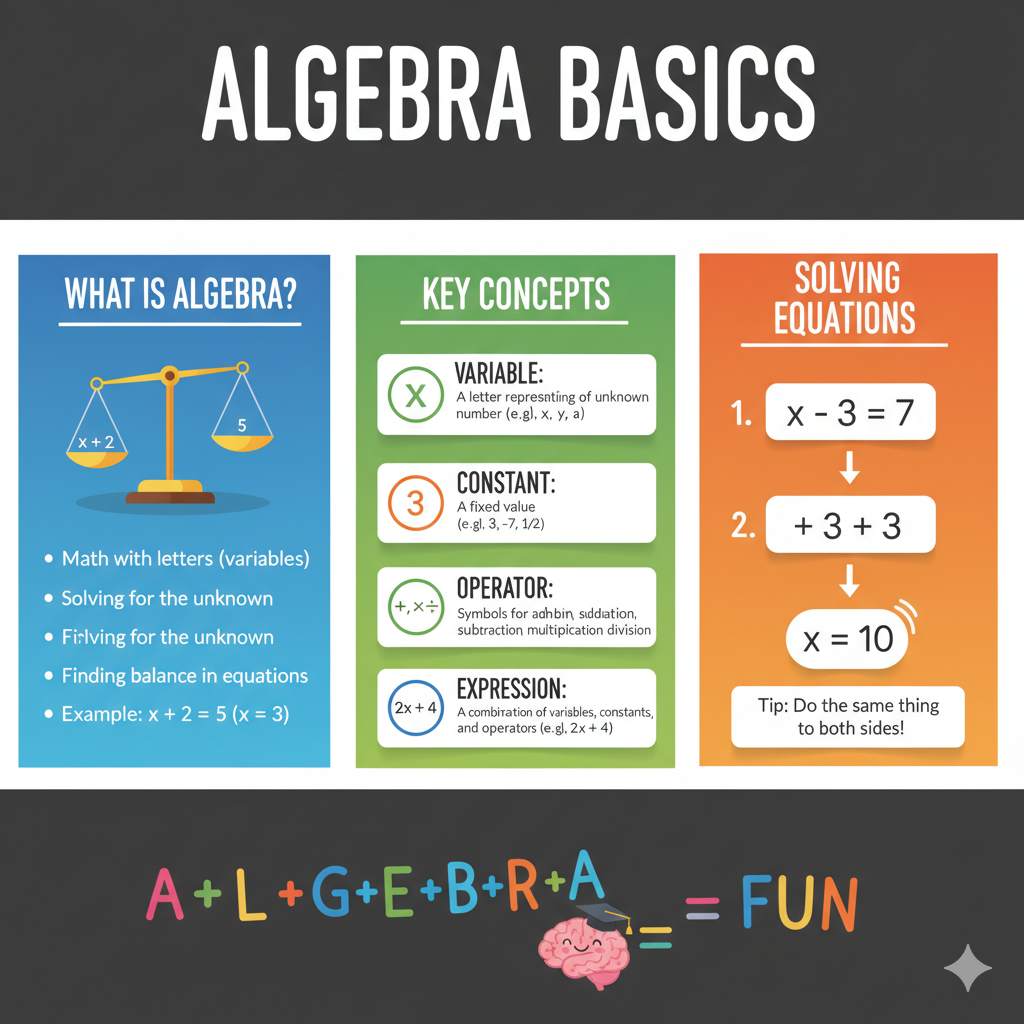
Algebra — Class 10 · 50 MCQ Maths Quiz (with step-by-step solutions)
Click Show solution for each question to see a simple step-by-step explanation on MCQ maths Quiz.
-
Q1. Solve: x + 3 = 7
- 2
- 3
- 4
- 5
Show solution
- Start: x + 3 = 7.
- Subtract 3 from both sides: x = 7 − 3.
- So x = 4.
Answer: (c) 4
-
Q2. Solve: 2x − 5 = 9
- 5
- 6
- 7
- 8
Show solution
- 2x − 5 = 9 → add 5 both sides: 2x = 14.
- Divide by 2: x = 14 ÷ 2 = 7.
Answer: (c) 7
-
Q3. Solve: 3x = 12
- 2
- 3
- 4
- 6
Show solution
- 3x = 12 → divide both sides by 3: x = 12 ÷ 3 = 4.
Answer: (c) 4
-
Q4. Solve: x / 2 = 6
- 8
- 10
- 12
- 14
Show solution
- x/2 = 6 → multiply both sides by 2: x = 6 × 2 = 12.
Answer: (c) 12
-
Q5. Solve: 5x + 2 = 17
- 1
- 2
- 3
- 4
Show solution
- 5x + 2 = 17 → subtract 2: 5x = 15.
- Divide by 5: x = 15 ÷ 5 = 3.
Answer: (c) 3
-
Q6. Roots of x² − 4 = 0 are:
- 2
- −2
- ±2
- 0
Show solution
- x² − 4 = 0 → x² = 4.
- Take square root: x = ±√4 = ±2.
Answer: (c) ±2
-
Q7. Expand: (x − 1)(x + 1) = ?
- x² + 1
- x² − 1
- x² − 2x
- x² + 2
Show solution
- Multiply: (x − 1)(x + 1) = x² + x − x − 1 = x² − 1.
Answer: (b) x² − 1
-
Q8. If x² = 25, then x = ?
- 5
- −5
- ±5
- 0
Show solution
- x² = 25 → x = ±√25 = ±5.
Answer: (c) ±5
-
Q9. Expand: (x + y)² = ?
- x² + y²
- x² + 2xy + y²
- x² − y²
- x² − 2xy + y²
Show solution
- (x + y)² = (x + y)(x + y) = x² + xy + yx + y² = x² + 2xy + y².
Answer: (b) x² + 2xy + y²
-
Q10. If (x + 2)(x + 3) = 0, then x = ?
- −2 only
- −3 only
- −2 or −3
- 2 or 3
Show solution
- Product zero → at least one factor is 0: x + 2 = 0 or x + 3 = 0.
- So x = −2 or x = −3.
Answer: (c) −2 or −3
-
Q11. Factorize: x² + 5x + 6
- (x + 1)(x + 6)
- (x + 2)(x + 3)
- (x − 2)(x − 3)
- (x + 3)(x − 2)
Show solution
- Find two numbers multiply 6 and add 5 → 2 and 3.
- So factorization: (x + 2)(x + 3).
Answer: (b) (x + 2)(x + 3)
-
Q12. Solve: x² − 5x + 6 = 0
- 1 & 6
- 2 & 3
- −2 & −3
- −2 & 3
Show solution
- Factor: x² − 5x + 6 = (x − 2)(x − 3) = 0.
- So x = 2 or x = 3.
Answer: (b) 2 & 3
-
Q13. Solve: 2x² − 8 = 0
- 2
- −2
- ±2
- 0
Show solution
- 2x² − 8 = 0 → 2x² = 8 → x² = 4.
- x = ±2.
Answer: (c) ±2
-
Q14. Simplify: (x² − y²) / (x − y) (x ≠ y) = ?
- x + y
- x − y
- xy
- x² − y²
Show solution
- Use identity x² − y² = (x − y)(x + y).
- Divide by (x − y) → result x + y.
Answer: (a) x + y
-
Q15. Solve: 3(x − 2) = 9
- 4
- 5
- 6
- 7
Show solution
- 3(x − 2) = 9 → divide both sides by 3: x − 2 = 3.
- So x = 3 + 2 = 5.
Answer: (b) 5
-
Q16. Solve: 4x + 7 = 3x + 12
- 2
- 3
- 4
- 5
Show solution
- 4x + 7 = 3x + 12 → subtract 3x: x + 7 = 12.
- x = 12 − 7 = 5.
Answer: (d) 5
-
Q17. Solve: x / 3 + 2 = 7
- 12
- 15
- 18
- 21
Show solution
- x/3 + 2 = 7 → subtract 2: x/3 = 5.
- Multiply by 3: x = 15.
Answer: (b) 15
-
Q18. Evaluate at x = 2: 3x² + x − 4 = ?
- 8
- 9
- 10
- 11
Show solution
- Compute x² = 4 → 3×4 = 12.
- Then 12 + x − 4 = 12 + 2 − 4 = 10.
Answer: (c) 10
-
Q19. If f(x) = 2x + 1, find f(3).
- 5
- 6
- 7
- 8
Show solution
- f(3) = 2×3 + 1 = 6 + 1 = 7.
Answer: (c) 7
-
Q20. Sum of roots of x² − 7x + 10 = 0 is:
- 10
- 7
- −7
- −10
Show solution
- For ax² + bx + c, sum = −b/a. Here a = 1, b = −7 → sum = −(−7)/1 = 7.
Answer: (b) 7
-
Q21. Product of roots of x² − 7x + 10 = 0 is:
- 7
- 10
- −10
- 1
Show solution
- Product = c/a = 10/1 = 10.
Answer: (b) 10
-
Q22. Solve: x² + 4x + 4 = 0
- −2
- 2
- ±2
- No real root
Show solution
- x² +4x +4 = (x + 2)² = 0 → x + 2 = 0.
- So x = −2 (double root).
Answer: (a) −2
-
Q23. Factorize: x² − 9
- (x − 9)
- (x − 3)(x + 3)
- (x + 9)
- (x − 1)(x + 9)
Show solution
- x² − 9 = (x − 3)(x + 3) (difference of squares).
Answer: (b) (x − 3)(x + 3)
-
Q24. If a² − b² = 15 and a − b = 3, then a + b = ?
- 3
- 5
- 15
- 45
Show solution
- a² − b² = (a − b)(a + b) = 15.
- Given a − b = 3 → (3)(a + b) = 15 → a + b = 15 ÷ 3 = 5.
Answer: (b) 5
-
Q25. Simplify: (2x³) / x (x ≠ 0) = ?
- 2x²
- x²
- 2x³
- x
Show solution
- Divide powers: x³ / x = x^(3−1) = x². Multiply by 2 → 2x².
Answer: (a) 2x²
-
Q26. Solve: 2(x − 1) = x + 3
- 3
- 4
- 5
- 6
Show solution
- 2x − 2 = x + 3 → subtract x: x − 2 = 3.
- x = 5.
Answer: (c) 5
-
Q27. Solve: x² − x − 6 = 0
- 3 & −2
- 2 & −3
- −3 & 2
- None
Show solution
- Factor: (x − 3)(x + 2) = 0 → x = 3 or x = −2.
Answer: (a) 3 & −2
-
Q28. Solve: 5x − 2 = 3(x + 4)
- 5
- 6
- 7
- 8
Show solution
- 5x − 2 = 3x + 12 → subtract 3x: 2x − 2 = 12.
- 2x = 14 → x = 7.
Answer: (c) 7
-
Q29. Simplify: (x² + 2x) / x (x ≠ 0) = ?
- x
- x + 2
- x² + 2x
- 2x
Show solution
- Split: (x² + 2x)/x = x²/x + 2x/x = x + 2.
Answer: (b) x + 2
-
Q30. Expand: (x + 1)² = ?
- x² + 2x + 1
- x² − 2x + 1
- x² + 1
- x² + 2
Show solution
- (x + 1)² = x² + 2x + 1 (standard formula).
Answer: (a) x² + 2x + 1
-
Q31. For AP with a₁ = 2 and d = 3, the 5th term = ?
- 11
- 12
- 14
- 16
Show solution
- nth term: aₙ = a₁ + (n − 1)d. For n = 5 → a₅ = 2 + 4×3 = 2 + 12 = 14.
Answer: (c) 14
-
Q32. Solve: |x| = 3 → x = ?
- 3
- −3
- ±3
- 0
Show solution
- |x| = 3 means distance from 0 is 3 → x = 3 or x = −3.
Answer: (c) ±3
-
Q33. Solve: x² − 16 = 0
- 4
- −4
- ±4
- 0
Show solution
- x² = 16 → x = ±4.
Answer: (c) ±4
-
Q34. Solve: 2x² + 3x − 2 = 0
- ½ and −2
- −½ and 2
- 1 and −2
- None
Show solution
- Use formula or factor: Discriminant Δ = 3² − 4×2×(−2) = 9 + 16 = 25.
- x = [−3 ± √25] / (2×2) = [−3 ± 5]/4 → x₁ = (2)/4 = 1/2, x₂ = (−8)/4 = −2.
Answer: (a) ½ and −2
-
Q35. Expand: (x − 2)² = ?
- x² − 4x + 4
- x² + 4x + 4
- x² − 2x + 4
- x² + 2x + 4
Show solution
- (x − 2)² = x² − 4x + 4 (use formula).
Answer: (a) x² − 4x + 4
-
Q36. Simplify: (x³ − y³) / (x − y) (x ≠ y) = ?
- x² − xy + y²
- x² + xy + y²
- (x + y)²
- None
Show solution
- Use identity x³ − y³ = (x − y)(x² + xy + y²).
- Divide by (x − y) → x² + xy + y².
Answer: (b) x² + xy + y²
-
Q37. Solve: x² + x = 6
- 2 and −3
- −2 and 3
- 1 and −6
- None
Show solution
- Bring all terms: x² + x − 6 = 0 → factor (x + 3)(x − 2) = 0.
- So x = 2 or x = −3.
Answer: (a) 2 and −3
-
Q38. Solve: 3x² − 12x + 12 = 0
- 2
- −2
- ±2
- None
Show solution
- Divide by 3: x² − 4x + 4 = 0 → (x − 2)² = 0.
- So x = 2 (double root).
Answer: (a) 2
-
Q39. Factorize: 4x² − 9
- (2x − 3)(2x + 3)
- (4x − 9)
- (2x − 9)(2x + 1)
- (x − 3)(4x + 3)
Show solution
- 4x² − 9 = (2x)² − 3² → difference of squares = (2x − 3)(2x + 3).
Answer: (a) (2x − 3)(2x + 3)
-
Q40. If x + y = 10 and xy = 21, find x² + y².
- 58
- 50
- 42
- 100
Show solution
- (x + y)² = x² + 2xy + y². So x² + y² = (x + y)² − 2xy.
- (x + y)² = 10² = 100. Then x² + y² = 100 − 2×21 = 100 − 42 = 58.
Answer: (a) 58
-
Q41. Expand: (2x + 3)² = ?
- 4x² + 12x + 9
- 4x² + 6x + 9
- 2x² + 9
- None
Show solution
- (2x + 3)² = (2x)² + 2·2x·3 + 3² = 4x² + 12x + 9.
Answer: (a) 4x² + 12x + 9
-
Q42. Solve: 3(x + 1) = 2(2x + 5)
- −7
- 7
- −3
- 3
Show solution
- 3x + 3 = 4x + 10 → subtract 3x: 3 = x + 10 → x = 3 − 10 = −7.
Answer: (a) −7
-
Q43. Solve: x² + 2x = 0
- 0 and −2
- 0 only
- −2 only
- None
Show solution
- x² + 2x = x(x + 2) = 0 → x = 0 or x + 2 = 0 → x = −2.
Answer: (a) 0 and −2
-
Q44. For x² − kx + 16 = 0 to have equal roots, k = ?
- 8
- −8
- ±8
- 0
Show solution
- Equal roots → discriminant Δ = b² − 4ac = k² − 4×1×16 = k² − 64 = 0.
- So k² = 64 → k = ±8.
Answer: (c) ±8
-
Q45. Remainder when x³ − 2x² + x − 2 is divided by (x − 1) = ?
- −2
- 2
- 0
- 1
Show solution
- Remainder theorem: remainder = P(1).
- P(1) = 1 − 2 + 1 − 2 = −2.
Answer: (a) −2
-
Q46. If x + y = 5 and x − y = 3, find x.
- 4
- 3
- 1
- 2
Show solution
- Add equations: (x + y) + (x − y) = 5 + 3 → 2x = 8 → x = 4.
Answer: (a) 4
-
Q47. Expand: (x + y)³ = ?
- x³ + 3x²y + 3xy² + y³
- x³ + y³
- (x + y)²
- None
Show solution
- Use binomial formula: (x + y)³ = x³ + 3x²y + 3xy² + y³.
Answer: (a) x³ + 3x²y + 3xy² + y³
-
Q48. Solve: x² − 6x + 9 = 0
- 3
- −3
- ±3
- None
Show solution
- x² − 6x + 9 = (x − 3)² = 0 → x = 3.
Answer: (a) 3
-
Q49. Solve: 7x + 5 = 3(2x + 1)
- −2
- 2
- −1
- 1
Show solution
- 7x + 5 = 6x + 3 → subtract 6x: x + 5 = 3 → x = 3 − 5 = −2.
Answer: (a) −2
-
Q50. Solve: x/4 + x/2 = 30
- 20
- 30
- 40
- 60
Show solution
- x/4 + x/2 = 30. Convert x/2 = 2x/4 → so (x + 2x)/4 = 30 → 3x/4 = 30.
- Multiply both sides by 4: 3x = 120 → x = 120 ÷ 3 = 40.
Answer: (c) 40
Tip: practice the steps slowly — isolate x, simplify step-by-step, and check your answer by substituting back.MCQ Maths Quiz
50 Trigonometry MCQs — with step-by-step solutions (kid-friendly)
How to use: For each question, read the choices (a–d). Click Show solution to see simple steps and the final answer. I explain like you’re learning from scratch.
-
Q1. What is
sin 30°?- a) 1/2
- b) √3/2
- c) √2/2
- d) 1
Show solution
- Remember the special angles:
sin 30° = 1/2. - Final answer: a) 1/2.
-
Q2. What is
cos 60°?- a) 1/2
- b) √3/2
- c) -1/2
- d) √2/2
Show solution
- From special angles:
cos 60° = 1/2. - Final answer: a) 1/2.
-
Q3. What is
tan 45°?- a) 0
- b) 1
- c) √3
- d) -1
Show solution
tan θ = sin θ / cos θ. For 45°, both sin and cos = √2/2, so tan = (√2/2)/(√2/2) = 1.- Final answer: b) 1.
-
Q4. What is
sin 45°?- a) 1/2
- b) √3/2
- c) √2/2
- d) 1
Show solution
- Special angle:
sin 45° = √2/2. - Final answer: c) √2/2.
-
Q5. What is
cos 30°?- a) 1/2
- b) √2/2
- c) √3/2
- d) 0
Show solution
- Special angle:
cos 30° = √3/2. - Final answer: c) √3/2.
-
Q6. What is
csc 30°? (csc = 1/sin)- a) 2
- b) 1/2
- c) √2
- d) √3
Show solution
sin 30° = 1/2. Socsc 30° = 1 / (1/2) = 2.- Final answer: a) 2.
-
Q7. What is
sec 60°? (sec = 1/cos)- a) 1
- b) 2
- c) √3
- d) 1/2
Show solution
cos 60° = 1/2. Sosec 60° = 1 / (1/2) = 2.- Final answer: b) 2.
-
Q8. What is
cot 45°? (cot = 1/tan)- a) 0
- b) 1
- c) -1
- d) undefined
Show solution
tan 45° = 1. Socot 45° = 1 / 1 = 1.- Final answer: b) 1.
-
Q9. What is
tan 30°?- a) √3
- b) √2/2
- c) √3/3
- d) 1
Show solution
tan 30° = 1/√3 = √3/3(we rationalize denominator: 1/√3 × √3/√3 = √3/3).- Final answer: c) √3/3.
-
Q10. What is
sin 90°?- a) 0
- b) 1
- c) -1
- d) undefined
Show solution
- Special angle:
sin 90° = 1. - Final answer: b) 1.
-
Q11. If
sin θ = 3/5and θ is in quadrant I, what iscos θ?- a) 4/5
- b) -4/5
- c) 3/5
- d) -3/5
Show solution
- Use identity
sin²θ + cos²θ = 1. - Compute
cos²θ = 1 - sin²θ = 1 - (3/5)² = 1 - 9/25 = 16/25. - So
cos θ = ±√(16/25) = ±4/5. In quadrant I, cos is positive →4/5. - Final answer: a) 4/5.
-
Q12. If
cos θ = -√3/2, and 0° ≤ θ < 360°, which θ is correct?- a) 30°
- b) 150°
- c) 210°
- d) 330°
Show solution
- cos(30°) = √3/2 (positive). We need negative √3/2 → cos is negative in quadrant II and III.
- cos 150° = cos(180° – 30°) = -cos 30° = -√3/2. So θ = 150° fits.
- Final answer: b) 150°.
-
Q13. Solve
tan θ = -1for 0° ≤ θ < 360°.- a) 45° and 225°
- b) 135° and 315°
- c) 90° and 270°
- d) 0° and 180°
Show solution
- tan 45° = 1. We want -1. Tangent is negative in quadrants II and IV.
- Angles with magnitude 45° in QII and QIV are 180° – 45° = 135° and 360° – 45° = 315°.
- Final answer: b) 135° and 315°.
-
Q14. What is
sin(π/6)?- a) 1/3
- b) 1/2
- c) √3/2
- d) √2/2
Show solution
π/6 = 30°. Sosin(π/6) = sin 30° = 1/2.- Final answer: b) 1/2.
-
Q15. What is
cos(π/4)?- a) √3/2
- b) √2/2
- c) 1/2
- d) 1
Show solution
π/4 = 45°, andcos 45° = √2/2.- Final answer: b) √2/2.
-
Q16. Evaluate
sin 75°exactly.- a) (√6 + √2)/4
- b) (√6 – √2)/4
- c) √3/2
- d) 1/2
Show solution
- Use sum formula:
sin(45°+30°) = sin45 cos30 + cos45 sin30. - Compute:
sin45 = √2/2, cos30 = √3/2, cos45 = √2/2, sin30 = 1/2. - So
sin75 = (√2/2)(√3/2) + (√2/2)(1/2) = √2/2 * ( (√3/2) + (1/2) ) = √2/2 * ( (√3+1)/2 ) = (√2(√3+1))/4. - Rewrite:
(√6 + √2)/4. - Final answer: a) (√6 + √2)/4.
-
Q17. Evaluate
cos 15°exactly.- a) (√6 – √2)/4
- b) (√6 + √2)/4
- c) √3/2
- d) 1/2
Show solution
- Use formula:
cos(45° - 30°) = cos45 cos30 + sin45 sin30. - Plug values:
(√2/2)(√3/2) + (√2/2)(1/2) = (√6 + √2)/4. - Final answer: b) (√6 + √2)/4.
-
Q18. What is
tan 15°simplified?- a) √3 – 1
- b) 2 – √3
- c) √3/3
- d) 1/2
Show solution
- Use difference formula:
tan(45°-30°) = (tan45 - tan30)/(1 + tan45 tan30). - tan45=1, tan30=1/√3. So numerator =
1 - 1/√3, denominator =1 + 1/√3. - Multiply numerator and denominator by √3: numerator =
√3 - 1, denominator =√3 + 1. - So tan15 =
(√3 - 1)/(√3 + 1). Rationalize by multiplying top and bottom by (√3 – 1): ((√3 - 1)²)/((√3 + 1)(√3 - 1)) = (3 - 2√3 +1)/(3 -1) = (4 - 2√3)/2 = 2 - √3.- Final answer: b) 2 – √3.
-
Q19. If
sin θ = 3/5andcos θ = 4/5, what issin 2θ?- a) 7/25
- b) 24/25
- c) 6/25
- d) 1
Show solution
- Formula:
sin 2θ = 2 sin θ cos θ. - Compute:
2 × (3/5) × (4/5) = 2 × 12 /25 = 24/25. - Final answer: b) 24/25.
-
Q20. If
sin θ = 3/5andcos θ = 4/5, what iscos 2θ?- a) 7/25
- b) -7/25
- c) 24/25
- d) 1
Show solution
- Formula:
cos 2θ = cos²θ - sin²θ. - Compute:
cos²θ = (4/5)² = 16/25,sin²θ = (3/5)² = 9/25. - So
cos 2θ = 16/25 - 9/25 = 7/25. - Final answer: a) 7/25.
-
Q21. Solve
sin x = 1/2for 0° ≤ x < 360°.- a) 30° only
- b) 150° only
- c) 30° and 150°
- d) 210° and 330°
Show solution
- sin x = 1/2 at reference angle 30°. Sine positive in QI and QII → x = 30°, 180° – 30° = 150°.
- Final answer: c) 30° and 150°.
-
Q22. Solve
cos x = -1for 0° ≤ x < 360°.- a) 0°
- b) 90°
- c) 180°
- d) 360°
Show solution
- cos x = -1 at x = 180° (unit circle leftmost point).
- Final answer: c) 180°.
-
Q23. Solve
tan x = √3for 0° ≤ x < 360°.- a) 60° and 240°
- b) 30° and 210°
- c) 120° and 300°
- d) 150° and 330°
Show solution
- tan 60° = √3. Tan has period 180°, so x = 60° + k·180° gives 60° and 240° in [0,360).
- Final answer: a) 60° and 240°.
-
Q24. What is the value of
sec²θ - tan²θin terms of constants?- a) 0
- b) 1
- c) sec θ
- d) tan θ
Show solution
- Identity:
1 + tan²θ = sec²θ. Rearranged →sec²θ - tan²θ = 1. - Final answer: b) 1.
-
Q25. If
sin θ = -√2/2, what are possible θ in [0°,360°)?- a) 45° and 135°
- b) 225° and 315°
- c) 135° and 225°
- d) 30° and 330°
Show solution
- sin = -√2/2 has reference angle 45°. Negative in QIII and QIV → angles 180° + 45° = 225°, and 360° – 45° = 315°.
- Final answer: b) 225° and 315°.
-
Q26. What is
arcsin(1)in degrees?- a) 0°
- b) 45°
- c) 90°
- d) 180°
Show solution
- sin 90° = 1, and arcsin returns principal value 90° (or π/2 radians).
- Final answer: c) 90°.
-
Q27. What is
arccos(0)in degrees?- a) 0°
- b) 45°
- c) 90°
- d) 180°
Show solution
- cos 90° = 0, so arccos(0) = 90° (principal value).
- Final answer: c) 90°.
-
Q28. What is
arctan(1/√3)in degrees?- a) 15°
- b) 30°
- c) 45°
- d) 60°
Show solution
- tan 30° = 1/√3, so arctan(1/√3) = 30°.
- Final answer: b) 30°.
-
Q29. Convert
150°to radians.- a) 5π/6
- b) 2π/3
- c) π/3
- d) 3π/4
Show solution
- Radians = degrees × π/180 →
150 × π/180 = 15/18 π = 5/6 π. - Final answer: a) 5π/6.
-
Q30. Convert
π/3to degrees.- a) 30°
- b) 45°
- c) 60°
- d) 90°
Show solution
- Degrees = radians × 180/π →
(π/3) × 180/π = 60°. - Final answer: c) 60°.
-
Q31. Solve
2 sin² x - 1 = 0for 0° ≤ x < 360°.- a) 0°, 180°
- b) 45°, 135°, 225°, 315°
- c) 30°, 150°
- d) 90°, 270°
Show solution
- Equation →
sin² x = 1/2. So|sin x| = 1/√2. - Reference angle = 45°. Values where sin = ±1/√2 are x = 45°, 135°, 225°, 315°.
- Final answer: b) 45°, 135°, 225°, 315°.
-
Q32. What is
cos 210°?- a) √3/2
- b) -√3/2
- c) -1/2
- d) 1/2
Show solution
- 210° = 180° + 30°. cos(180° + α) = -cos α. So cos 210° = -cos30° = -√3/2.
- Final answer: b) -√3/2.
-
Q33. What is
sin(-30°)?- a) 1/2
- b) -1/2
- c) √3/2
- d) -√3/2
Show solution
- sin is odd:
sin(-θ) = -sin θ. sin 30° = 1/2 → sin(-30°) = -1/2. - Final answer: b) -1/2.
-
Q34. What is
tan 225°?- a) -1
- b) 0
- c) 1
- d) undefined
Show solution
- 225° = 180° + 45°. tan(180° + θ) = tan θ. So tan 225° = tan 45° = 1.
- Final answer: c) 1.
-
Q35. If
sin θ = -4/5and θ is in quadrant III, what iscos θ?- a) 3/5
- b) -3/5
- c) 4/5
- d) -4/5
Show solution
- Use
sin² + cos² = 1. sin² = (−4/5)² = 16/25. So cos² = 1 – 16/25 = 9/25 → cos = ±3/5. - In quadrant III, cosine is negative →
-3/5. - Final answer: b) -3/5.
-
Q36. Which identity is always true?
- a) 1 + tan²θ = sec²θ
- b) 1 + sin²θ = cos²θ
- c) tan θ = cos θ / sin θ
- d) sec θ = sin θ
Show solution
- Known Pythagorean identity is
1 + tan²θ = sec²θ. Other options are false or reversed. - Final answer: a) 1 + tan²θ = sec²θ.
-
Q37. Evaluate
sin 15°exactly.- a) (√6 + √2)/4
- b) (√6 – √2)/4
- c) √3/2
- d) 1/2
Show solution
- Use
sin(45° - 30°) = sin45 cos30 - cos45 sin30. - Compute:
(√2/2)(√3/2) - (√2/2)(1/2) = √2/2 * ( (√3/2) - (1/2) ) = (√6 - √2)/4. - Final answer: b) (√6 – √2)/4.
-
Q38. What is
cos 120°?- a) 1/2
- b) -1/2
- c) -√3/2
- d) √3/2
Show solution
- 120° = 180° – 60°. cos(180° – α) = -cos α → cos120° = -cos 60° = -1/2.
- Final answer: b) -1/2.
-
Q39. What is
sec 45°?- a) 1
- b) √2
- c) 2
- d) √3
Show solution
- sec = 1/cos. cos45° = √2/2 → sec45° = 1 / (√2/2) = 2/√2 = √2.
- Final answer: b) √2.
-
Q40. What is
csc 225°?- a) √2
- b) -√2
- c) 1/2
- d) -1/2
Show solution
- 225° = 180° + 45°. sin225° = -sin45° = -√2/2.
- csc = 1/sin → csc225° = 1 / (-√2/2) = -2/√2 = -√2.
- Final answer: b) -√2.
-
Q41. In a right triangle, angle A = 30°, hypotenuse = 10. What is the length of the side opposite angle A?
- a) 5
- b) 10√3/2
- c) 10/2
- d) both a) and c)
Show solution
- Opposite = hypotenuse × sin 30° = 10 × 1/2 = 5.
- Options a) and c) are same number; final answer: d) both a) and c) (but simplest: 5).
-
Q42. In a right triangle, angle B = 60°, adjacent side to B = 8. What is the hypotenuse?
- a) 8
- b) 16
- c) 8/2
- d) 4
Show solution
- cos 60° = 1/2 = adjacent/hypotenuse → hypotenuse = adjacent / cos60° = 8 / (1/2) = 16.
- Final answer: b) 16.
-
Q43. In a right triangle, opposite = 3 and hypotenuse = 5. What is
cos θ(θ is the angle opposite the 3)?- a) 3/5
- b) 4/5
- c) 5/3
- d) 1/2
Show solution
- Use Pythagoras: adjacent side = √(hyp² – opp²) = √(25 – 9) = √16 = 4.
- cos θ = adjacent/hypotenuse = 4/5.
- Final answer: b) 4/5.
-
Q44. What is
sin(90° - θ)equal to?- a) sin θ
- b) cos θ
- c) -sin θ
- d) -cos θ
Show solution
- Co-function identity:
sin(90° - θ) = cos θ. - Final answer: b) cos θ.
-
Q45. What is the period (in degrees) of the function
sin x?- a) 90°
- b) 180°
- c) 360°
- d) 720°
Show solution
- The sine function repeats every 360° (or 2π radians).
- Final answer: c) 360°.
-
Q46. What is
sin(2π/3)?- a) √3/2
- b) -√3/2
- c) 1/2
- d) -1/2
Show solution
2π/3 = 120°. sin 120° = sin(180° – 60°) = sin 60° = √3/2.- Final answer: a) √3/2.
-
Q47. What is
cos(3π/4)?- a) √2/2
- b) -√2/2
- c) 0
- d) -1
Show solution
3π/4 = 135°. cos 135° = -cos 45° = -√2/2.- Final answer: b) -√2/2.
-
Q48. Simplify
sin² x - cos² xin terms of double angle.- a) cos 2x
- b) -cos 2x
- c) sin 2x
- d) -sin 2x
Show solution
- We know
cos 2x = cos² x - sin² x. Sosin² x - cos² x = - (cos² x - sin² x) = -cos 2x. - Final answer: b) -cos 2x.
-
Q49. If
tan θ = 3/4and θ in quadrant I, what issin θ?- a) 3/5
- b) 4/5
- c) 5/3
- d) 3/4
Show solution
- Think right triangle: tan = opp/adj = 3/4. Hypotenuse = √(3² + 4²) = √(9 + 16) = √25 = 5.
- So sin θ = opp/hyp = 3/5.
- Final answer: a) 3/5.
-
Q50. Solve
sin x = 0for 0° ≤ x < 360°.- a) 0° and 180°
- b) 90° and 270°
- c) 45°, 135°, 225°, 315°
- d) 30° and 150°
Show solution
- sin x = 0 at x = 0°, 180°, 360°… For 0° ≤ x < 360°, the solutions are 0° and 180°.
- Final answer: a) 0° and 180°.
✅ Tips if you’re learning:
- Memorize key values for 0°, 30°, 45°, 60°, 90° (sin, cos, tan).
- Remember identities:
sin²x + cos²x = 1,1 + tan²x = sec²x, double-angle and sum formulas. - For solving equations, find reference angle then pick the correct quadrant based on sign.
Number Theory
Number theory focuses on properties and relationships of integers, including prime numbers, divisibility, and modular arithmetic.
🧠 10 Essential MCQs on Elementary Number Theory
Test your understanding of number theory concepts with these carefully selected questions.
1. What is the smallest prime number?
Options: A) 0 B) 1 C) 2 D) 3
Answer: C) 2
Explanation: The number 2 is the smallest prime number, as it is divisible only by 1 and itself. It’s also the only even prime number.
2. Which of the following numbers is divisible by 3?
Options: A) 123 B) 124 C) 125 D) 126
Answer: A) 123
Explanation: A number is divisible by 3 if the sum of its digits is divisible by 3. For 123, 1 + 2 + 3 = 6, which is divisible by 3.
3. What is the greatest common divisor (GCD) of 56 and 98?
Options: A) 14 B) 28 C) 7 D) 49
Answer: A) 14
Explanation: The prime factorizations are 56 = 2³ × 7 and 98 = 2 × 7². The GCD is the product of the lowest powers of common prime factors: 2¹ × 7¹ = 14.
4. Which number is a perfect square?
Options: A) 50 B) 64 C) 75 D) 80
Answer: B) 64
Explanation: A perfect square is an integer that is the square of another integer. 64 = 8², so it is a perfect square.
5. What is the least common multiple (LCM) of 15 and 20?
Options: A) 30 B) 60 C) 75 D) 90
Answer: B) 60
Explanation: The LCM is found by taking the highest powers of all prime factors. 15 = 3 × 5 and 20 = 2² × 5. LCM = 2² × 3 × 5 = 60.
6. Which of the following is a prime number?
Options: A) 49 B) 51 C) 53 D) 55
Answer: C) 53
Explanation: 53 is divisible only by 1 and itself, making it a prime number.
7. What is the remainder when 12345 is divided by 9?
Options: A) 0 B) 1 C) 2 D) 3
Answer: A) 0
Explanation: A number is divisible by 9 if the sum of its digits is divisible by 9. 1 + 2 + 3 + 4 + 5 = 15, and 15 ÷ 9 leaves a remainder of 6. Therefore, the remainder is 6.
8. Which of the following numbers is a perfect cube?
Options: A) 27 B) 64 C) 125 D) 216
Answer: D) 216
Explanation: A perfect cube is an integer that is the cube of another integer. 216 = 6³, so it is a perfect cube.
9. What is the greatest common divisor (GCD) of 81 and 243?
Options: A) 27 B) 54 C) 81 D) 243
Answer: C) 81
Explanation: The prime factorizations are 81 = 3⁴ and 243 = 3⁵. The GCD is the product of the lowest powers of common prime factors: 3⁴ = 81.
10. Which number is a perfect square and a perfect cube?
Options: A) 16 B) 64 C) 81 D) 100
Answer: B) 64
Explanation: 64 = 8² = 4³, so it is both a perfect square and a perfect cube.
For more MCQs on Elementary Number Theory, visit Ground Mint’s Number Theory Section.
Geometry
Geometry MCQs with Shapes
1. How many sides does this shape have?
2. What is the shape below?
3. Find the perimeter of this square (side = 5 cm).
4. What is the sum of angles in a triangle?
5. Identify this 5-sided figure.
6. How many diagonals does a square have?
7. Find the area of a rectangle (length=8 cm, width=5 cm).
8. What is the radius if circle’s diameter = 10 cm?
9. A hexagon has how many sides?
10. The sum of angles of a quadrilateral is?
More MCQ Maths questions with answers
11. Find the perimeter of rectangle (l=10, w=6).
12. How many edges does a cube have?
13. How many faces does a cube have?
14. How many vertices does a cube have?
15. Find the area of triangle (base=6, height=4).
16. How many sides does an octagon have?
17. What is the diameter of a circle if radius = 7 cm?
18. How many sides does a decagon have?
19. The interior angle of a regular hexagon is?
20. Find the circumference of a circle (radius = 7 cm). (Use π ≈ 22/7)
Practice more MCQs on geometry here MCQ Maths questions
📊 Class 10 Statistics – 20 Interactive MCQs Maths questions with Graphs
Solve 20 MCQ Maths questions with visual graphs and detailed solutions. Click Show Solution to learn step by step.
Practice more MCQs on class 10 statisticsFrequently Asked Questions
Discover Calculus Bridges
Learn how dental calculus forms, prevent buildup, and maintain sparkling teeth easily every day.